Showing posts with label History. Show all posts

Museum of History Ethnography Melaka

I had been visiting Museum of History, Ethnography & literature Melaka last year. The museum located in the red Stadhuys, at the junction of City Road and Church Street, Malacca. You can see the 'Dutch Square' infront of the building full of tourists all the time. The Dutch Square is Victorian Water Fountain and Tan Beng Seng Clock Tower built in 1886. Stadthuys (" town hall "in Dutch) were built in 1650 as an official settlement of the Dutch Governor and Deputy Governor, in which these structures represent the fine art of Dutch design.

Muzium Melaka

red Stadhuys

The museum open everyday (including Public Holidays) with a fee of RM5.00 for adults and RM2.00 for Children. It open from 9am until 5.30pm on weekdays and from 9am until 9pm on Saturday & Sunday. Museum of History is located on level two and Museum of Ethnografi is located on level one in the Stadthuys Building. If you love history and looking at old things like me, you have to spend 2 hours to visit this museum.

Pistol Antik

Syiling timah Portugis

Museum of History is located at the level of a display of the scene that became the cornerstone of Malaysia's history starts from the opening day of Malacca to the Portuguese colonial era, Dutch, English, Japanese until the country achieved independence. Ethnografi Museum gives special attention to the lifestyle of local communities of diverse races Malay, Chinese, Indian, Baba Nyonya, Chetti and Portuguese. The picture on the marriage customs, way of life, used equipment, musical instruments of choice and cultivated forms of agriculture is the main focus of the museum.

Syiling Melaka

Most of the coins collection are donated by Tony Lye Fong Nge, one of Malaysia Numismatic Celebrity and also author of The collection of Malacca coinage Book. This museum is a must visit place if you ever go to Melaka. You can also visit my new facebook page for more photos: Museum of History Ethnography Melaka.
Read More...

Gambar duit syiling Malaysia

Here are gambar duit syiling Malaysia or Malaysia coins pictures for anyone who are looking for pictures or photo of Malaysia coins. I also added duit baru Malaysia (Malaysia new coins) pictures that had been released by BNM (Bank Negara Malaysia) on end of July 2011. Looking at Malaysia coins history (Sejarah duit Malaysia), BNM change Malaysia new coins after over 20 years. In this post, I am sharing Malaysia coin pictures from 1st to the new third series.


Duit Syiling Malaysia Siri Pertama


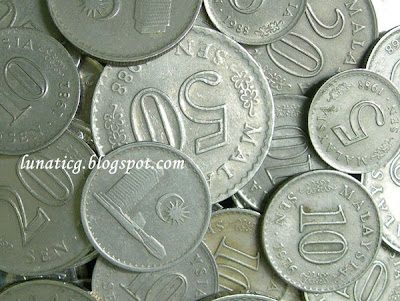
The first series of sen coins were introduced in 12 June 1967 in denominations of 1 sen, 5 sen, 10 sen, 20 sen, 50 sen, followed by the introduction of the 1 ringgit coin (which continued to use the $ symbol and is the largest coin in the series) in 1 May 1971. The first series coins are also called the Parliament series because of the parliament pictures on the reverse of the coins.


Duit Syiling Malaysia Siri Kedua.


The second series of coin for normal circulation was issued on 4 September 1989. The new design feature Malaysia national flower, the Bunga Raya (hibiscus flower) on the reverse of the coins. On the Obverse, BNM has chosen Malaysia Cultural artifact Keris, Wau, Tepak Sirih, Congkak, Gasing and Rebana Ubi. The second series coins are also known as Bunga Raya series coins.


Duit Syiling Malaysia Siri Ketiga


BNM Governor, Tan Sri Dr Zeti Akhtar Aziz released Malaysia 2012 new coins design in end of July 2011. 500,000 sets of the new coins will be available as a commemorative coins (Brilliant Uncirculated) with special packaging and to be sold to the public at RM 10.00 per set in all BNM branches. The coins were designed by a Malaysian and wholly minted by Bank Negara's mint in Malaysia. The theme, 'Distinctively Malaysia', features motifs from traditional crafts and our flora and fauna. The coins reflect the diversity and richness of Malaysia's national identity. Read More.


Read More...

First Floating Commemoration

World’s first floating commemoration to mark the 500th anniversary of the maiden voyage of the Mary Rose revealed by Royal Mint early this month. A replica of the Mary Rose £2 coin was put on the ship resting place in the Solent. The ship was launched in 1511 and sank in 1545 during an engagement with French fleet. The three meter replica coin is a reproduction of the £2 Mary Rose coin released by the Royal Mint earlier this year.


Shane Bissett, the Royal Mint’s Director of Commemorative Coin commented "We produced the Mary Rose coin as a tribute to the world’s only surviving Tudor warship – and hope it serves as a reminder of Britain’s rich heritage as a maritime nation. In our 1,000-year history, we have never ‘floated’ a coin before, but there seemed no better way to celebrate the 500th anniversary of such an iconic vessel. Collaborating with the Mary Rose Trust and the Royal Navy Fleet Diving Squadron to execute the idea at sea was an honor, as we remember our naval past and look to its future."


John Lippiett, Chief Executive of the Mary Rose Trust said "We are delighted to continue our relationship with the Royal Mint following production of the Mary Rose £2 coin. We have much work to do to secure the future of the ship and we are grateful to everyone who supports our fundraising drive to help us build the new Mary Rose Museum here in Portsmouth Historic Dockyard. Building work is underway and we plan to open it before the end of 2012. Our hope is that people will send a Mary Rose £2 coin back to us here in Portsmouth to help us achieve our target."


Lieutenant Commander Richard Watson, Chief of Staff at the Royal Navy Fleet Diving Squadron added "Not only does the Mary Rose play an important part in Britain’s military history, but the story of this Tudor warship appeals to naval personnel and civilians alike. We were able to combine some of our training with this task and are proud to help the Royal Mint commemorate the Mary Rose and hope that the new £2 coin helps keep her memory alive."


The Mary Rose £2 gold proof coin will find its way into our change this year. Only 1,511 22 carat gold commemorative coin have been struck, reflecting the year of the Mary Rose’s maiden voyage. The coins have also been struck in sterling silver and pristine, uncirculated versions are available to buy in limited numbers.


Mary Rose £2 Gold Proof Coin


The reverse features an intricately detailed depiction of the Mary Rose that was inspired by the only known contemporary painting of her. It was created by John Bergdahl FRBS who explains: ‘After a trip to the museum currently the home to the Mary Rose, I was immediately inspired by the only acknowledged painting of this iconic vessel – an image that I used as the basis for my design.’


Technical Specification:
Denomination: M
Alloy: 22 Carat Gold
Weight: 15.976 g
Diameter: 28.40 mm
Minted: 1,511 pcs


Source: Royal Mint


Read More...

The Most Famous Ancient Coin

The Most Famous Ancient Coin in History, The "Ides of March", Silver Denarius minted by Julius Caesar assassin Marcus Brutus will be auctioned by Heritage auction on 9 September 2011. The coin pre-auction estimate is $500,000+ and if it reach that, it will establish a record price for a Roman silver coin. The coin has been in collection of many famous people including Hollywood producer Sy Weintraub and the actor Peter Weller. It was also in the world-famous Nelson Bunker Hunt Collection. Since the early part of the 2000s, the coin has been part of a private Arizona holding.


The dime-sized silver coin depicts the head of Marcus Junius Brutus, one of the ringleaders of the assassination plot, on its obverse. The reverse depicts a dome-shaped liberty cap (traditionally given to freed slaves), flanked by two drawn daggers and the Latin inscription EID MAR “Ides of March”. The dome-shaped liberty cap and two drawn daggers indicates Brutus' intention of freeing Rome from Caesar's imperial ambitions and the murder weapons employed to do so. The coin celebrated an assassination of Julius Caesar on the 15 March 44 BC.

Marcus Junius Brutus were born about 85 BC. Brutus was from a long line of Romans famous for resisting tyranny and defending Republican liberty. He was a close friend and protĆ©gĆ© of Julius Caesar, but when Caesar seized power as Dictator in 49 BC, Brutus joined the Republican forces opposed to him. After the defeat of the Republicans the following year, Caesar pardoned Brutus and gave him every preferment. As Caesar became more megalomaniacal, however, Brutus joined the conspiracy against him and is said to have delivered the fatal dagger thrust, prompting Caesar’s final words (spoken in Greek), “You too, my child?”

Brutus had carried out the attack with some fellow Roman Senators in 44 BC when Caesar had come unarmed to address the Senate on 15 March. This day was known to the Romans as the ides, or the middle day of the month and was recognised on a new calendar system that Caesar himself had established just two years before.

After the murder, the conspirators or “freedom party” fled Rome to Macedonia to raise an army. Brutus assembled a pro-Republican power base in Macedonia (Greece) where he could wage war against Caesar’s successors, Mark Antony and Octavian. Looting gold and silver from the local population, he began to strike coins to pay his growing army. Amongst the coins the conspirators briefly struck to this end was this, the 'Ides of March' denarius.

In a final twist of fate, Brutus used the same dagger he had plunged into Caesar to take his own life following his final defeat at the second battle of Philippi on 23 October 42 BC. The Eid Mar denarii became rare because the type was deliberately recalled and melted down by the victors, Mark Antony and Octavian.

Source: Heritage Auction, British Museum.

Read More...

Most valuable coins in the world

What are the most valuable coins in the world today? This are some collection that most of us will probably don't afford to buy. Don't waste your time asking around where to get this for your collection. The best thing you can get maybe a replica for this coins but don't get cheated by thinking that a seller has sold you a jackpot. For your information, most of the worlds valuable collection come from United States since they're lots of collectors over there. Here are my list of most valuable coins in the worlds:


1. World's most expensive coin: 1794 silver dollar


A 1794 silver dollar owned by Steven L. Contursi. He owned the mint-condition 1794 Liberty dollar for the past seven years. The Neil/Carter/Contrusi 1794 flowing hair dollar, sold for $7.85 million to the Cardinal Collection Educational Foundation of Sunnyvale. The Name "Neil/Carter/Contrusi 1794 flowing hair dollar" came from the previous owner of the coin. The previous record price paid for a coin was $7.59 million for a U.S.-minted 1933 $20 double eagle gold piece, according to the American Numismatic Association.


On the reverse: The dollar coin shows a small eagle perched upon a rock with wings spread and surrounded by laurel branches. Along the border is the motto “United States of America.”
On the edge: Has the words “HUNDERED CENTS ONE DOLLAR OR UNIT” inscribed with decorations separating the words.


2. The King of Coins-King of Siam 1804 silver dollars minted in 1834


The first 1804 silver dollars minted in 1834 were presented as gifts to Rama III, King of Siam and Said bin Sultan, Sultan of Muscat and Oman. The other five were dispersed under unknown circumstances after Ambassador Edmund Roberts died en route during the voyage. One was retained in the US Mint Coin Collection. In 1842, numismatists first learned of the 1804 dollar through a book displaying an illustration of the 1804 dollar from the Mint Cabinet. These silver dollars are known among numismatists as “original” or Class I 1804 dollars. Eight of these coins are known to exist. One currently resides in the Smithsonian Institution, one is in the American Numismatic Association museum, and the other six are in private collections.

Popular legend states that the rare coin given by King Rama IV of Siam to Anna Leonowens, as seen in the story of “Anna and the King of Siam” and the movie The King and I, was indeed the same 1804 silver dollar produced in 1834 as a gift to Siam. This coin was kept in Anna’s family for several generations, until in the 1950s it was sold by a pair of British ladies claiming to be Anna’s descendants. This coin was displayed as part of the “King of Siam” collection at the Smithsonian Institution in 1983, where it was given the name “the King of Coins.” It was purchased by an anonymous collector in 2001, who purchased the entire set of coins from the King of Siam collection for over $4 million.


3. World's largest gold coin; Royal Canadian Mint Million-dollar coin

Photo by Reuters: It need 3 men's to lift up the coin.

On 3rd May 2007, the Royal Canadian Mint (RCM) unveiled a Gold Maple Leaf coin by artist Stanley Witten, with a face value of $1 million Canadian dollar. The weight of the coin is 100 kilograms, and measures 50 cm in diameter by 3 cm thick. In October 2007, the Million Dollar Coin was certified by Guinness World Records to be the world's largest gold coin. . The reverse features an elegant, hand-polished maple leaf design by Royal Canadian Mint artist and senior engraver Stan Witten, and the obverse bears the effigy of Her Majesty Queen Elizabeth II by celebrated Canadian portrait artist Susanna Blunt. The coins are both adorned with a maple leaf and boast 99.999 percent purity, a notch above previous purity peaks of 99.99 percent. One of this coin had been auctioned by Vienna auction house, Dorotheum; ORO direct, a Spanish precious metals trading company bought the world's largest gold coin for 3.27 million euros ($4.02 million).


4. Mona Lisa of Rare Coins: 1913 Liberty Head nickel


Photo by Heritage Auctions Gallery

A rare 1913 American nickel five-cent piece also known as The Liberty Head nickel, sometimes referred to as the V nickel due to its reverse design, Recently dubbed "The Mona Lisa of Rare Coins," was sold for more than $3.7 million (2.3 million pounds) in Heritage Auctions Platinum Night. The so-called Liberty Head nickel, one of only five known of that specific date and design, was sold "in spirited bidding" to a private East Coast coin collector in Orlando late on Thursday, said Greg Rohan, president of Dallas, Texas-based Heritage Auctions. The buyer wished to remain anonymous.


5. World's most expensive penny -1943D Lincoln cent


A Lincoln cent struck in the wrong metal at the Denver Mint in 1943, has been sold for a world's record price of $1,700,000 by Legend Numismatics of Lincroft, New Jersey. The buyer is a Southwestern business executive, who wants to remain anonymous. The historic World War II era coin's former owner arranged for the entire proceeds of the sale to be given to a charitable organization. This one of a kind Lincoln cent, mistakenly struck in 1943 at the Denver Mint in bronze rather than the zinc-coated steel used that year to conserve copper for World War II. Most 1943 pennies are steel-gray in color and not worth much more than face value.


6. Worlds most expensive gold dinar-The Umayyad dinar


A specialist auctioneers, Morton & Eden in London, make it in a record book for Worlds most expensive gold dinar and Dirham. The Umayyad dinar, one of the rarest and most highly-prized of all Islamic gold coins, struck possibly to coincide with an occasion when the Caliph himself led the Hajj pilgrimage to Mecca, sold for a record £3,720,000 in a sale at specialist auctioneers Morton & Eden in London. The Umayyad dinar, dated 105h (723AD) was struck from gold mined at a location owned by the Caliph himself; known on the coins as the “Mine of the Commander of the Faithful”. An additional legend which reads: “bi’l-Hijaz” (“in the Hejaz”), makes it the earliest Islamic coin to mention a location in the Kingdom of Saudi Arabia.

Do you have any suggestion for Worlds most valuable coins? Share with us in here.
Read More...

A history of gold by The Telegraph

Gold is the most popular metal as an investment. Investors generally buy gold as a hedge or safe haven against any economic crises. While searching for any new news yesterday, I found a "History of gold" post by The Telegraph. It tells the history of gold between the timeline. Gold had been going up over USD$1400 per ounces this year and most probably will not stop since many people fear about the inflation and financial crises.

worlds first coin,lydian lion

3600 BC - First smelting of gold
Egyptian goldsmiths carry out the first melting or fusing of ores in order to separate the metals inside. They use blowpipes made from fire-resistant clay to heat the smelting furnace.

2600 BC - Early gold jewellery
Goldsmiths of ancient Mesopotamia (modern-day Iraq) craft one of the earliest pieces of gold jewellery, a burial headdress of lapis and carnelian beads with willow leaf-shaped gold pendants.

1223 BC - Creation of Tutankhamun's funeral mask
Instantly recognised the world over, the funeral mask of Tutankhamun is a triumph of gold craftsmanship from the ancient world.

564 BC - First international gold currency created
King Croesus develops improved gold refining techniques, permitting him to mint the world's first standardised gold currency. Their uniform gold content allows 'Croesids' to become universally recognised and traded with confidence.

1300 - Hallmarking practice established
The world's first hallmarking system, scrutinising and guaranteeing the quality of precious metal, is established at Goldsmith's Hall in London - where London's Assay Office is still located today.

1370 - The Great Bullion Famine begins
During the years 1370-1420, various major mines around Europe become completely exhausted. Mining and production of gold declines sharply throughout the region in a period known as 'The Great Bullion Famine'.

1717 - UK gold standard commences
Britain moves onto a de facto pure gold standard, as the government links the currency to gold at a fixed rate (establishing a mint price of 77 shillings, 10-and-a-half pennies per ounce of gold).

1848 - California Gold Rush begins
John Marshall discovers gold flakes while building a sawmill near Sacramento, California. The greatest gold rush of all time follows as 40,000 diggers flock to California from around the world.

1885 - South African gold rush begins
While digging up stones to build a house, Australian miner George Harrison finds gold ore on Langlaagte farm near Johannesburg. Miners flock to the region. South Africa will go on to become the source of 40pc of the world's gold.

1870-1900 - Adoption of gold standard
All major countries other than China switch to the gold standard, linking their currencies to gold. The practice of bimetallism is abandoned.

1925 - Gold standard returns
The UK returns to the gold standard at pre-war parity of $4.86=£1 with sterling convertible to gold at 77sh 10.5d per standard ounce. This follows the country's departure from the gold standard six years previously at the outbreak of the First World War.

1933 - Roosevelt suspends gold
President Roosevelt suspends US dollar convertibility to gold (gold at US$20.67/oz). The export of all transactions in, and the holding of gold by private individuals, is forbidden. Presidential proclamation makes the dollar convertible again in January 1934 at a new price of $35 per troy ounce.

1939 - Second World War closes gold market
The London gold market is closed on the outbreak of war, as at the beginning of the Second World War. The world will later return to a fixed system of exchange rates, this time with currencies fixed to the dollar and the dollar convertible into gold.

1961 - First gold in space
The first manned space flight uses gold to protect sensitive instruments from radiation. In 1980, 41kgs of gold is included in space shuttle construction through brazing alloys, fuel cell fabrication and electrical contacts.

1967 - First South African Krugerrand
The Krugerrand is introduced in 1967, as a vehicle for private ownership of gold. This iconic coin is actually intended for circulation as currency.

1971 - Gold window closed
The Bretton Woods system of fixed exchange rates comes to an end as President Nixon "closes the gold window", suspending US dollar convertibility to gold. The world enters its present day system of floating exchange rates.

1999 - First Central Bank Gold Agreement
The First Central Bank Gold Agreement (CBGA) is agreed. 15 European central banks declare that gold will remain an important element of their reserves and collectively cap gold sales at 400 tonnes per year over next five years.

2004 - Launch of SPDR Gold Shares
The market is transformed by an innovative, secure and easy way to access the gold market. Seven years later SPDR exceeds $55bn in assets under management.

2009 - Central banks return to buying
In the second quarter of the year, central banks collectively become net purchasers of gold for the first time in two decades. This reflects a combination of slowing sales from European banks and growing purchases by emerging market countries.

2010 - Gold price sustains record highs
Fiat currencies are undermined by inflation fears and successive financial crises. The London pm fix achieves 35 separate successive highs in the year to date.

Source: Telegraph.co.uk

Related Posts:
Read More...

Bank Negara Malaysia Logo issue

Issue of Bank Negara Malaysia (BNM) has been going on quiet a while now. Many people are discussing about it in forums or in their blogs. The main issue is whether the logo symbolize a Pharaoh dog or Barking deer. Most of their article are debating why the deer tail in BNM logo are longer then normal deer should be. There is no official statement by BNM about this but there is an email reply by BNM staff circulating in Internet stating that BNM logo idea suggested by the late Malaysia Bank governor Tun Ismail Mohd. Ali and come from Kelantan old coins.

Photo: BNM logo on the left, Kelantan gold kupang on the right.

Photo: Kelantan coat of Arms

Many people who don't understand, misinterpret the Kelantan Kijang. Maybe they were thinking that Kelantan coin that people were talking about is Kelantan gold dinar that have a Kelantan coat of arms on it. They were telling people that the kijang (deer) in BNM logo is totally different then Kelantan coat of arms. The kijang in BNM logo had a longer tail then kijang in Kelantan coat of arms. That is true but BNM logo exactly come from Kelantan Kijang Gold Kupang coin. The kupang gold had been used long time ago, 14th or 17th century. Thats mean the logo had been used for at least 600 years old. The kijang in this coin had a longer tail then today kijang.

There is no written history about how Kelantan put kijang in their kupang. One is the view which associates the coins with Che Siti Wan Kembang, a female ruler in Kelantan. Her reign was rather obscure as one historian places her in the 14th century while another puts her in the 17th century. According to local folklore, some Arab traders presented a Kijang to the Queen. She became very fond of her pet and had it inscribed on the gold coins. Another version was linked to the influence of Saivite Hinduism. The connection was based on the fact that the earliest issue of Kijang coins resembled the Indian humped-back bull and the bull motif was depicted on the ancient Hindu coins which were circulated in the Northern Malay States.

Photo: Young Barking deer

Bank Negara Malaysia officially stated that their logo come from Malaysia Barking deer or Muntiacus muntjak. They're called as the "barking deer" due to the bark-like sound that it makes as an alarm when danger is present. The Indian Muntjacs specifically are widespread throughout Southern Asia, but are one of the least known Asian animals. Paleontological evidence proves that Indian Muntjacs have been around since the late Pleistocene epoch at least 12,000 years ago.

The Muntjacs' coat is golden tan on the dorsal side and white on the ventral side of the body, the limbs are dark brown to reddish brown, and the face is dark brown. However, the ears have very little hair which barely covers them. Male muntjacs have antlers that are very short, about 1-2 inches, usually consisting of only two or three points at the most and protrude from long body hair covered pedicels on the forehead. Females have tufts of fur and small bony knobs where the antlers are located in males. Males also have slightly elongated upper canines about an inch long that curve slightly outward from the lips. The tail may be raised in alarm to show the white area as a signal of danger.

Photo by neveryetmelted.com: How deer raised its tail.

Correct me if I am wrong but BNM logo don't come from Pharaoh hound dog. It came from a 600 years old coin widely used in Kelantan long time ago and known as Kelantan Kijang Gold Kupang. I wish BNM can give their official statement regarding this.

Source: Wikipedia, Malay-coins.tripod.com.


Read More...

King of Siam coin

A reader asked me "What is King of Siam coin"? He heard a friends is selling his King of Siam coin at adorable price but the coin is a 1804 United States coin not Thailand (Siam). Is this some kind of fake or a scam or is this for real? How much is the value? To that particular reader, I suggest you search anything you want to buy at a high price like that in the Internet first before making any decision. Its not that hard to do some research about anything nowadays. Just go to Google and type what information you want to search. Yes.., that coin a fake. 1804 silver dollar is very rare and you can only see them in museum or private collections. Real 1804 silver dollar is worth millions dollars, fake only cost you few hundreds ringgit. 

In 1804, United States Mint records indicate that 19,750 silver dollars were struck. However, in keeping with common Mint practice at the time, these were all minted from old but still-usable dies dated 1803, and are indistinguishable from the coins produced the previous year. Silver dollars dated 1804 did not appear until 1834, when the U.S. Department of State was creating sets of coins to present as gifts to certain rulers in Asia in exchange for trade advantages. The U.S. Government ordered the Mint to produce "two specimens of each kind now in use, whether of gold, silver or copper". Since the silver dollar was still in use, but had last been recorded as produced in 1804, Mint employees struck several dollars with an 1804 date. Due to the cost-cutting measures of the US Mint in its early history and the reuse of 1803 dies, this act led to confusion.

The first 1804 silver dollars minted in 1834 were presented as gifts to Rama III, King of Siam and Said bin Sultan, Sultan of Muscat and Oman. The other five were dispersed under unknown circumstances after Ambassador Edmund Roberts died en route during the voyage. One was retained in the US Mint Coin Collection. In 1842, numismatists first learned of the 1804 dollar through a book displaying an illustration of the 1804 dollar from the Mint Cabinet. These silver dollars are known among numismatists as “original” or Class I 1804 dollars. Eight of these coins are known to exist. One currently resides in the Smithsonian Institution, one is in the American Numismatic Association museum, and the other six are in private collections.

Popular legend states that the rare coin given by King Rama IV of Siam to Anna Leonowens, as seen in the story of “Anna and the King of Siam” and the movie The King and I, was indeed the same 1804 silver dollar produced in 1834 as a gift to Siam. This coin was kept in Anna’s family for several generations, until in the 1950s it was sold by a pair of British ladies claiming to be Anna’s descendants. This coin was displayed as part of the “King of Siam” collection at the Smithsonian Institution in 1983, where it was given the name “the King of Coins.” It was purchased by an anonymous collector in 2001, who purchased the entire set of coins from the King of Siam collection for over $4 million.

Value:  1.00 U.S. dollar
Mass Class I:  26.96 g 
Mass Class II: 24.711 g 
Class III: 27.15-27.41 g 
Diameter:   39-40 mm 
Edge Class I:  Lettered - HUNDRED CENTS ONE DOLLAR OR UNIT
Class II: Plain
Class III: Lettered - HUNDRED CENTS ONE DOLLAR OR UNIT
Composition:  90.0% Ag 10.0% Cu
Years of minting:  Class I - 1834; Class II, Class III - 1858-1860.

Obverse: Design Bust of Liberty facing right
Designer:  Robert Scot
Design date:  1804

Reverse: Design Heraldic representation of the Great Seal of the United States with UNITED STATES OF AMERICA around the rim.
Designer:  Robert Scot

Source: Wikipedia
There is no easy money in numismatic world nowadays. If that deal is too good to be true, most probably they're trying to selling fake items. I got so many phone call or sms like that. But some people do get lucky finding treasure in their own backyard.

Related Posts:


Read More...

1976 bronze 1 sen story

Do you know there are few 1976 bronze 1 sen found in circulation? For anyone who still don't know, only bronze variety for this coin is rare and have a high value. I don't remember if I show any of this coin before, on sell or in my friends collection. Normal copper clad steel only prize at least RM3 for uncirculated. Its not easy to get them and not easy to spot bronze coin. Someone suggest using magnet to differentiate copper clad steel from bronze. You just put together the 1 sen 1976 coin and look for coin that not attach for that magnet and that mean it is a bronze variety.

Photo: this are only normal 1976 coin.

Do you know how this bronze variety get out into circulation? Here is a story told to me Dickson. a frequent reader of my blog:
In 1973, when Bank Negara found out the production cost of the 1973 1 cent copper is higher than the face value,they decided to replace with copper-clad steel blank. As a result, half of the 1973 1 cent coins produced in copper-clad steel.

In 1976,a staff of Bank Negara found some 1976 1 cent coins stuck in the coin counting machine.The coin counting machine was adjusted to detect only 1 cent coin in copper-clad steel in 1973. Apparently, 1 cent coin in copper-clad steel is lighter than copper blank and attracted to magnet.The staff took out those stuck coins and reported to his superior.They found out this coins was minted on copper planchet.

A post-mortem was conducted by them.They traced it to the mint factory. Here are what they found out:
when they clear the floor of the minting area which is full of all sizes planchets,they separated those planchet for future minting because each planchet is accounted for.However, they missed to separate the copper planchets form the copper-clad steel planchets for 1 cent coins. So when times to mint 1976 1 cent coins, this mixed planchets was used. Some of the planchets include this bronze variety.
Malaysia Numismatic Society traced the owners of this rare coins. So far only 19pcs, mostly in UNC condition are known. We called this the Transitional Error. Current price, RM1000 offered. So far no seller.

Latest news on 1976 one cent bronze, l was told by a collector (an ex-staff of Bank Negara) changed RM4000.00 worth of old one cent coins (equivalent to 400000 pieces),when finished checking, he found 4pcs of used 1970 one cent coin and lucky enough to find one piece of used 1976 one cent Bronze.

If you know any owners of this rare piece,please update us to add into the list.

I don't think I saw any of that in my life Dickson. I received many email asking me if their coin is the 1976 1 sen collector were looking for but most of the time its only the normal copper. I am still searching for the best way to show in this blog on how to differiantiate between copper and bronze. Maybe we can get a positive result about this coin after that. To anyone who own this Malaysia 1 sen bronze variety, feel free to show it to me at lunaticg@gmail.com. You will be helping other collectors a lot by just one clear picture of your collection.

If you have any information regarding Malaysia coin story, please email me about it at lunaticg@gmail.com. Every information will get a free link to any of your Blog, website, sales page (eBay, Mudah.my etc) or even your email. I don't publish any story that had been written by someone before or your ads for selling your items. It will be easy if you can provide me with written story and clear pictures of the items. Any pictures publish in this blog, I will put lunaticg blog watermark to prevent others from plagiat or copy the story. Please tell me if you don't want me to publish your question or story in here.


Read More...

Its easy to throw money

I have been visiting Melaka famous A Famosa Fort recently. While visiting the big fort, I found out that some people like to throw their money in a well and some open graveyard. Its easy to throw money or is it because throwing money is a tradition that we cannot doing? To anyone who have not going to A famosa, it is a fortress located in Malacca, Malaysia. It is among the oldest surviving European architectural remains in Asia. The Porta de Santiago, a small gate house, is the only remaining part of the fortress still standing.

Photo: Melaka Famous "The Porta De Santiago".

Why do people throw money in a well, fountain or lake? Most people do that after they make a wish. In most cases, they throw coins or put some offering near that well or fountain. Some maybe wishing about their life and throw a penny. Its been going on for a very long time. When I am talking with some friends in Melaka recently, he told me that people throw some pretty good collection in there. People working in that place found some gold and old coins when its time to clean that place. I don't know if that true but the tradition of throw a wish with your coin sound fascinating to me.

Photo: A Wishing well.

A wishing well is a term from European folklore to describe wells where it was thought that any spoken wish would be granted. The idea that a wish would be granted came from the idea that water housed deities or had been placed there as a gift from the gods, since water was a source of life and often a scarce commodity. People believe that the guardians or dwellers of the well would grant them their wish if they paid a price. After uttering the wish, one would generally drop coins in the well. That wish would then be granted by the guardian or dweller, based upon how the coin would land at the bottom of the well.

In Rome, Italy, an estimated 3,000 euros are thrown into the Trevi Fountain each day. A traditional legend holds that if visitors throw a coin into the fountain, they are ensured a return to Rome. Among those who are unaware that the "three coins" of Three Coins in the Fountain were thrown by three different individuals, a reported current interpretation is that two coins will lead to a new romance and three will ensure either a marriage or divorce. A reported current version of this legend is that it is lucky to throw three coins with one's right hand over one's left shoulder into the Trevi Fountain.

Photo: This is suppose to be a graveyard but you can see money thrown away.

In ancient Greece it was an offering to the Naiad nymph of the spring or well. She was an important spirit, for if the fountain ran dry the town would be without water. In Greek mythology, the Naiads or Naiades were a type of nymph who presided over fountains, wells, springs, streams, and brooks. The god of merchants, Hermes, also had luck oracles where people would toss a coin into the sacred spring and the priest would interpret the meaning by how it fell.

According to ancient mythology such as MĆ­mir's Well from Nordic myths, also known as the "Well of Wisdom", a Well that could grant you infinite wisdom provided you sacrificed something you held dear. Odin was asked to sacrifice his right eye which he threw into the well to receive not only the wisdom of seeing the future but the understanding of why things must be. MĆ­mir is the Nordic god of wisdom, and his well sits at the roots of Yggdrasil, the World Tree which draws its water from the well.

Any of you make a wish lately?

Source: Wikipedia.

Related Posts:
Read More...

British North Borneo coin Story

Do you know, Sabah once called North Borneo and Kota Kinabalu once called Jesselton? The story of North Borneo started when Alfred Dent taking control of the lands from Austro-Hungarian Empire in Hong Kong, Baron Von Overbeck in 1880. In July 1881, Alfred Dent and his brother formed the British North Borneo Provisional Association Ltd and obtained an official Royal Charter November 1 the same year. In May 1882, the North Borneo Chartered Company replaced the Provisional Association. Sir Rutherford Alcock became the first President, and Alfred Dent became Managing Director.

Photo: a map of British North Borneo.

Photo: Aerial view of Jesselton or Kota Kinabalu in 1930.

In spite of some diplomatic protests by the Dutch, Spanish and Sarawak governments, the North Borneo Chartered Company proceeded to organize settlement and administration of the territory. The company subsequently acquired further sovereign and territorial rights from the sultan of Brunei, expanding the territory under control to the Putatan river (May 1884), the Padas district (November 1884), the Kawang river (February 1885), the Mantanani Islands (April 1885), and additional minor Padas territories (March 1898).

Photo: King Edward VII (Prince of Wales at that time) on his visit to North Borneo in 1922.

Photo: Jesselton police station in 1930.

The Company established a foundation for economic growth in North Borneo by restoring peace to a land where piracy and tribal feuds had grown rampant. It abolished slavery and set up transport, health and education services for the people. Chinese immigrants were wooed to boost the small population of less than 100,000. The Chartered Company's system of administration was based on standard British colonial administration structures, with the land divided into Residencies, and sub-divided into Districts. Initially, there were only two Residencies: East Coast and West Coast, with Residents based at Sandakan and Jesselton respectively.

Photo: 25 cents coin reverse.

In 1881, British North Borneo Company issued copper coins in values of ½ cent and 1 cent. In 1903, British North Borneo Company started to issued cupro-nickel coins in value of 1 cent, 2½ cents and 5 cents. In 1929, the 25 cents silver coin is minted. Their coin minted by Ralph and Sons Limited (In 1879, the mint change its name to The Mint Birmingham Limited). At this moment, British North Borneo coins is one of the hot item in Malaysia coin market. I only realize it when I visit Amcorp Mall flea market recently, only a few seller sells this 25 cents silver coin.

Photo: 25 cents coin obverse.

Photo: 1/2 cents coin obverse.

The obverse of the coins shows the Coat-of-Arms of the British North Borneo Chartered Company consisting of a shield within which is a native boat with sails and a lion above. Above the shield is a pair of hands grasping a flagstaff. The shield is supported by two natives (Dayak tribe), the one o the left holds a native shield and the one on the right holds a native sword. Below the sheild is the company motto ” PERGO ET PERAGO” in latin(translate: I undertake and I accomplish) with the mint mark “H” below. Only 1/2 cent copper had a different obverse with only a shield within which is a native boat with sails and a lion above.

Source: Wikipedia, Book:Sabah history in picture by Johan M. Padiasan.

Related Posts:
Read More...

Reunification of Germany Silver coin

Following the sell out of the 2009 Fall of the Berlin Wall 20-year commemorative, The Perth Mint is issuing a new coin marking the 20th anniversary of the reunification of East and West Germany, which came together on 3rd October 1990. The coin is struck by The Perth Mint from 1oz of 99.9% pure silver in proof quality. German reunification was the process in which the German Democratic Republic (East Germany) and Berlin, reunited into a single city, joined the Federal Republic of Germany (West Germany), as provided by its then Grundgesetz constitution Article 23. The end of the unification process is officially referred to as the German unity, celebrated on 3 October (German Unity Day).


Like its Berlin Wall predecessor, the coin’s reverse is composed around the number ‘20’. Elements include a coloured image of fireworks on a black, red and gold background, and a representation of the Quadriga, a chariot and four horses driven by the Roman goddess Victory, which sits atop the Brandenburg Gate in Berlin. As well as The Perth Mint’s ‘P’ mintmark, the reverse also features the inscription REUNIFICATION OF GERMANY OCTOBER 3RD 1990.

Issued as legal tender of Tuvalu, the coin depicts the Raphael Maklouf effigy of Her Majesty Queen Elizabeth II and the 2010 year-date on the obverse.

Technical Specifications:

Silver Content (Troy oz): 1
Monetary Denomination (TVD): 1
Fineness (% purity): 99.9
Minimum Gross Weight (g): 31.135
Maximum Diameter (mm): 40.60
Maximum Thickness (mm): 4.00

The Perth Mint will release no more than 5,000 of these coins. You can visit The Perth Mint for item viewing. Each coin is housed in superb presentation packaging comprising a display case and themed shipper. Each coin also accompanied by a numbered Certificate of Authenticity.

Source: Perth Mint, Wikipedia.

Related posts:
Read More...

Dutch East Indies coins for sale

I have some Dutch East Indies coins for sale. This one doit Batavian Republic coins are minted in Netherlands under Enkhuizen, Amsterdam, Utrecht and Hoorn Mint. All coins composition are copper. The best way to buy this is to come and see the coins yourself but you can try asked me what you're looking for. For anyone who are looking for Dutch East India Company (V.O.C., Verenidge Oostindische Compagnie), I also have some for sale.


A little bit of Dutch East Indies history:


The Dutch East India Company (Vereenigde Oost-Indische Compagnie or VOC in Dutch, literally "United East Indian Company") was a chartered company established in 1602, when the States-General of the Netherlands granted it a 21-year monopoly to carry out colonial activities in Asia. The Dutch East India Company remained an important trading concern for almost two centuries, paying an 18% annual dividend for almost 200 years. In its declining years in the late 18th century it was referred to as Vergaan Onder Corruptie (referring to the acronym VOC) which translates as 'Perished By Corruption'. The VOC became bankrupt and was formally dissolved in 1800, its possessions and the debt being taken over by the government of the Dutch Batavian Republic. The VOC's territories became the Dutch East Indies and were expanded over the course of the 19th century to include the whole of the Indonesian archipelago, and in the 20th century would form Indonesia.

The Dutch East Indies, or Netherlands East Indies, (Dutch: Nederlands-Indiƫ; Indonesian: Hindia-Belanda) was the Dutch colony that became modern Indonesia following World War II. It was formed from the nationalised colonies of the former Dutch East India Company that came under the administration of the Netherlands in 1800. During the nineteenth century, Dutch possessions in the archipelago and its hegemony were expanded, reaching their greatest extent in the early twentieth century. Following the World War II Japanese occupation, Indonesian nationalists declared Indonesian independence in 1945. Thereafter and as a consequence of the subsequent Indonesian National Revolution, the Netherlands formally recognised Indonesian sovereignty in December 1949.

In an 1806 to 1816 interregnum, during the Napoleonic Wars, the British took over administration of several Dutch East Indies posts including Java before Dutch control was restored. The 1824 Anglo-Dutch Treaty, ceded Dutch control of Malacca, the Malay Peninsula, and possessions in India ( Dutch India from 1609 ) to Great Britain in exchange for British settlements in Indonesia, such as Bengkulu in Sumatra. The capital of the Dutch East Indies was Batavia, now known as Jakarta, which remains the capital of the Indonesian republic.Currency Dutch East Indies Gulden

Item: Nederl Indie One cent -1840 (2 pcs), 1836 (1pc) & 1838 (1pc).
Item: Nederl indie 1/4 Stiver- 1823 (3 pcs) & 1824 (1pc).
Item: Indie batav 5 1/16 Guilders @One doit- 1803 (1pc), 1804 (2pcs), 1805 (1pc), 1806 (1pc), 1815 (3 pcs), 1816 (1 pc), 1818 (1pc), 1820 (3pcs) & 1823 (1pc).
Price: email me.
Negotiable: No.
COD: Port Klang. Please inform me a day early if you want to view the item.

I am a trusted seller. You can check my rating in lelong.com.my. You can also sms me via the lelong system to check if my phone number (017-2749427) is the valid phone number for lunaticg. I had been selling there since 2003 and stop selling in 2008. Verified in lelong system means I send a copy of my identity card to them. That mean, if I don't send your item, you can asked lelong about my detail.

Item is for sale within Malaysia only. You can e-mail me at lunaticg@gmail.com or 017-2749427 (sms only) for any enquiry about this sale. please stated the item ID or name that you're interested when you e-mail or sms me. i prefer communication via e-mail since we can check any chat history if any dispute arise. I will be sending my item via poslaju and posdaftar. Poslaju charges is at RM7.oo per item (you can combine item as long as the weight is not exceed 500 grammes). Posdaftar Charges is at RM4.00 per item (you can combine item as long as the weight is not exceed 150 grammes). Payment is via Maybank. I will send the details after you confirm want to buy the item. You can check my other item in lunaticg.blogspot sale page.

Related posts:
Read More...

2010 UK Florence Nightingale £2 Brilliant Uncirculated Coin Pack

A £2 coin Brilliant Uncirculated Coin Pack has been produce by Royal Mint UK to commemorate the 100th anniversary of Florence Nightingale death as well as the 150th anniversary of the publication of her Notes on Nursing falls in 2010. During the Crimean War Florence Nightingale took a team of nurses to Constantinople to care for the ill and critically injured troops and won the undying respect of the nation. The Informative presentation folder recounting her remarkable life and achievements are strictly limited to 25,000 worldwide.

The obverse of the coin bear the effigy of the Queen by the Rank-Broadley coins bear the inscription ELIZABETH II DEI GRA REG FID DEF. On the reverse show an image of an outstretched hand, with a second and third hand as if taking a pulse, surrounded by the inscription 1820 - FLORENCE NIGHTINGALE - 1910. The edge inscription: 150 YEARS OF NURSING.

Florence Nightingale, (12 May 1820 – 13 August 1910) was an English nurse, writer and statistician. She came to prominence during the Crimean War for her pioneering work in nursing, and was dubbed "The Lady with the Lamp" after her habit of making rounds at night to tend injured soldiers. Nightingale laid the foundation of professional nursing with the establishment, in 1860, of her nursing school at St Thomas' Hospital in London, the first secular nursing school in the world. The Nightingale Pledge taken by new nurses was named in her honour, and the annual International Nurses Day is celebrated around the world on her birthday.

During the Crimean campaign, Florence Nightingale gained the nickname "The Lady with the Lamp", deriving from a phrase in a report in The Times:
She is a ‘ministering angel’ without any exaggeration in these hospitals, and as her slender form glides quietly along each corridor, every poor fellow's face softens with gratitude at the sight of her. When all the medical officers have retired for the night and silence and darkness have settled down upon those miles of prostrate sick, she may be observed alone, with a little lamp in her hand, making her solitary rounds.

The phrase was further popularised by Henry Wadsworth Longfellow's 1857 poem "Santa Filomena":
Lo! in that house of misery
A lady with a lamp I see
Pass through the glimmering gloom,
And flit from room to room.

On 13 August 1910, at the age of 90, she died peacefully in her sleep in her room at 10 South Street, Park Lane. The offer of burial in Westminster Abbey was declined by her relatives, and she is buried in the graveyard at St. Margaret Church in East Wellow, Hampshire.

Specifications:

Denomination: £2
Alloy: Inner - Cupro-nickel, Outer - Nickel-brass
Weight: 12.00g
Diameter: 28.40mm
Designer: (Reverse) Gordon Summers
Designer: (Obverse) Ian Rank-Broadley FRBS
Edge: Inscription 150 Years of Nursing

Source: Royal Mint UK, Wikipedia.

Related Posts:
Read More...

Safank Fank

Video Gallery