Showing posts with label Ancient. Show all posts

Ancient treasure found and sold

Have you read a news in The Star today, Ancient treasure found and sold in Melaka. I think a news about people unearthed old Portuguese coins, bullets and religious amulets along the banks of the Malacca River had long been stop by the authority but look like nobody done nothing. From the news, sound like we can enjoy a free coin hunting along the Malacca River banks without any interruption by the museum authority. In the news, a scrap metal agent, Rafi, share that the most valuable of which found so far was a cannon ball that fetched RM500, were discovered after an ancient jetty at Stadhuys collapsed in May.
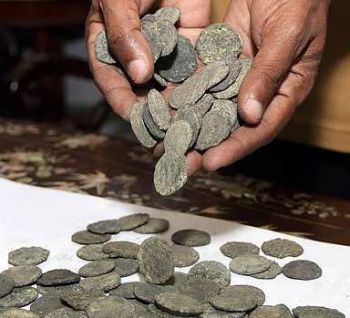
Melaka coin


They also found Chinese porcelain pieces and religious paraphernalia from the Malacca Sultanate as well as those from the Portuguese, Dutch and British colonial periods. The artefacts are believed to be about 500 years old.

“Also unearthed were bullets and cannons. For the past few days, I have joined six others in combing the river sediment for treasure," Rafi said.

“We have hit the jackpot! There are piles of these artefacts for our picking,” he said, adding that he made about RM1,000 a day by selling the items. Apparently, the brokers are from Singapore.

At the peak of the Malacca Sultanate and when the port was colonised by the Portuguese and Dutch, the river would have seen trading vessels from various countries, some of which could have capsized with their treasures.

Rafi said he was only armed with a ladle and hoe for his search, adding that although the relevant authorities “were aware of the find, nobody had stopped them from digging”.

“I know we should not sell these items but the offer is too tempting,” he said.

“We found mostly items from the Portuguese era. Despite being 500 years old, the coins are well-preserved with their carvings still visible. We have also discovered coins used by the Dutch East India Company.”

Expressing his regret that no effort was made to preserve these historical items, Portuguese-Eurasian Association president Michael Singho said it was ready to buy the artefacts and conserve them at their settlement in Ujong Pasir here.

“I will embark on a fund-raising drive to obtain the items back,” he said.

State Tourism, Culture and Heritage Committee deputy chairman Chua Kheng Hwa said he would bring up the discovery to Chief Minister Datuk Mohd Ali Rustam.

“The items are supposed to be handed over to the museum authority but these people are only interested in making a fast buck.”

Source: The Star.

OK guys, lets go on a hunting trip to Melaka river banks. Anyone want to join?

Read More...

The Most Famous Ancient Coin

The Most Famous Ancient Coin in History, The "Ides of March", Silver Denarius minted by Julius Caesar assassin Marcus Brutus will be auctioned by Heritage auction on 9 September 2011. The coin pre-auction estimate is $500,000+ and if it reach that, it will establish a record price for a Roman silver coin. The coin has been in collection of many famous people including Hollywood producer Sy Weintraub and the actor Peter Weller. It was also in the world-famous Nelson Bunker Hunt Collection. Since the early part of the 2000s, the coin has been part of a private Arizona holding.


The dime-sized silver coin depicts the head of Marcus Junius Brutus, one of the ringleaders of the assassination plot, on its obverse. The reverse depicts a dome-shaped liberty cap (traditionally given to freed slaves), flanked by two drawn daggers and the Latin inscription EID MAR “Ides of March”. The dome-shaped liberty cap and two drawn daggers indicates Brutus' intention of freeing Rome from Caesar's imperial ambitions and the murder weapons employed to do so. The coin celebrated an assassination of Julius Caesar on the 15 March 44 BC.

Marcus Junius Brutus were born about 85 BC. Brutus was from a long line of Romans famous for resisting tyranny and defending Republican liberty. He was a close friend and protégé of Julius Caesar, but when Caesar seized power as Dictator in 49 BC, Brutus joined the Republican forces opposed to him. After the defeat of the Republicans the following year, Caesar pardoned Brutus and gave him every preferment. As Caesar became more megalomaniacal, however, Brutus joined the conspiracy against him and is said to have delivered the fatal dagger thrust, prompting Caesar’s final words (spoken in Greek), “You too, my child?”

Brutus had carried out the attack with some fellow Roman Senators in 44 BC when Caesar had come unarmed to address the Senate on 15 March. This day was known to the Romans as the ides, or the middle day of the month and was recognised on a new calendar system that Caesar himself had established just two years before.

After the murder, the conspirators or “freedom party” fled Rome to Macedonia to raise an army. Brutus assembled a pro-Republican power base in Macedonia (Greece) where he could wage war against Caesar’s successors, Mark Antony and Octavian. Looting gold and silver from the local population, he began to strike coins to pay his growing army. Amongst the coins the conspirators briefly struck to this end was this, the 'Ides of March' denarius.

In a final twist of fate, Brutus used the same dagger he had plunged into Caesar to take his own life following his final defeat at the second battle of Philippi on 23 October 42 BC. The Eid Mar denarii became rare because the type was deliberately recalled and melted down by the victors, Mark Antony and Octavian.

Source: Heritage Auction, British Museum.

Read More...

Antoniniani roman coin found

Antoniniani Roman coin found in Colchester. The Hoard of Roman coins has been unearthed by archaeologists excavating a former barracks in Colchester. Two pots, one of them containing 1,247 coins, were discovered on the site of the former Hyderabad and Meeanee barracks, which are being redeveloped. The coins, known as antoniniani, date back to between 251 and 271 AD. Philip Crummy from the Colchester Archaeological Trust said the find would shed light on how people looked after their money in Roman times. The coins have been sent to the British Museum for analysis and will then be donated by developer Taylor Wimpey, which owns the land, to Colchester Museum.


Mr Crummy said: "What you're looking at is how somebody managed their savings, taking some out and putting some back in probably over a number of years.

"It does look as if there's no difference in terms of the dates of the coins at the bottom than at the top.

"In other words, the coins were probably put in the pot as one lump all at once.

"There was an identical pot right next to the one that was filled with coins which was empty.

"I think what happened here was it had coins in it and had been emptied and put back in the ground again in readiness for more coins."


The discovery is not the first example of buried coins to have been found in the Colchester area. More than 6,000 similar coins were found in the Gosbecks area of the town in 1983 and another stash of 600 was discovered in East Mersea in 1980. Mr Crummy explained the coins were originally buried at a time of public unrest and civil war.

He said: "Today we rather take banks for granted but in those days of course there were no banks, so they had a problem.

"If you kept it in your house it might get broken in to and stolen, so what many people did if they had lots of money was bury them in their garden or nearby field."

The coins are the latest significant finds to to be unearthed at the nine-hectare (22-acre) site. In April, the bones of two Anglo-Saxon soldiers were found and in 2005 the site of a Roman chariot circus was found in the gardens of the former sergeants' mess.

Source: BBC News
Read More...

Estonian rewarded 100,000 euros

An honest Estonian rewarded with nearly 100,000 euros for a pot of silver ancient coins he found last year. His identity was not made public. He turned in a treasure of more than a thousand ancient silver coins he dug up in a field in Estonia and got his reward on Thursday, when the Estonian government decided to give him nearly 100,000 euros.

Estonia Map by Wikipedia.

"Under Estonian law, a person who finds and turns over ancient treasure to the authorities is entitled to the half of its value," the Estonian government said on its website.

"An expert study by Estonian heritage authorities found the treasure is worth 198,126 euros ($273,000)," it said.

"Most of the nearly thousand years old coins; (80 percent of them) are from Germany and the rest from England, Sweden, Denmark and Hungary. One silver coin seems to be from Italy," Mauri Kiudsoo, a Tallinn University expert, told reporters in the Estonian capital Thursday.

The man made the rare discovery on August 16 last year while digging in a farmer's field near Tallinn. The treasure, contained in a broken clay pot, comprised 1,329 silver coins and nine other silver items. The find came three years to the day after the previous such discovery in Estonia, when five treasure hunters discovered a trove of almost 1,000 coins, mostly from the 17th century, on Saaremaa Island off the west coast. They were rewarded with 32,650 euros for handing in the money from Sweden, Germany and the Netherlands.

The recent introduction of the Estonia's euro coin has sparked controversy after it was claimed that a map of the tiny Baltic country on the new Estonian one euro coin appears to include a chunk of neighbouring Russia.

Source: AFP.
Read More...

Lydian donated to Mashhad Museum

Two early examples of Lydian coins, which were minted during the reign of King Croesus of Lydia (c. 560–546 BC), have been donated to the Astan-e Qods Razavi Library and Museum in Mashhad in Tehran, Iran. King Croesus of Lydia produced a bimetallic system of pure gold and pure silver coins, but the foundation deposit of the Artemisium (temple to Artemis) at Ephesus shows that coins minted from electrum (a gold-silver alloy) were in production before Croesus, possibly under King Gyges.Croesus’ earliest coins were of electrum, which the Greeks called “white gold”. They were stamped on one side with facing heads of a lion and a bull. This type was later transferred to his bimetallic series of pure gold and pure silver.

Photo by Tehran Times: Two Lydian coins.

“The coins bear an image of a lion hunting a bull on one side and two square-shaped cavities on the other side,” the museum’s Stamp, Coin and Banknote Section curator, Mohammad-Hossein Yazdinejad, said in a press release on Wednesday.

He said that the coins, which are showcased beside a collection of Achaemenid coins, have attracted lots of attention by visitors. Yazdinejad gave no details about the identity of the donor.

According to Britannica, true coinage appeared soon after 650 BC. The 6th-century Greek poet Xenophanes, quoted by the historian Herodotus, ascribed its invention to the Lydians, “the first to strike and use coins of gold and silver.” Some recent scholarship, however, suggests that this latter series was struck, in fact, under Croesus’ Persian successors.

Source: Tehran Times.


Read More...

Frome Hoard Campaign by Art Fund

Everyone of you must had been remember about 52,503 Roman coins found by Dave Crisp last April stuffed into a giant pot bellied jar, buried in a field near Frome. The largest coin hoard ever found in a single container in Britain has been valued at £320,250 after hours of debate and conflicting opinions from three experts. Art fund had lunched a campaign to save the Frome Hoard for Somerset museum in Taunton. Including five exceptionally rare silver coins minted for "the forgotten emperor" Carausius, who ruled Britain for seven years until he was murdered by his finance minister in 293 AD.

Photo: CHRISTOPHER PLEDGER-telegraph.co.uk

The fund will give an initial £40,250 to kick start the appeal, and will then match every pound given by the public up to a further £10,000. The British Museum will also give 50p from every copy of a new book about the find written by its experts. Most of the coins are comparatively low value, but include the largest collection ever found of Carausius coins, including some in fabulous condition, better than the British Museum's examples.

Stephen Deuchar, director of the Art Fund, said: "We're extremely excited to be part of Somerset's campaign to acquire this extraordinary treasure. To think that this pot packed full of coins lay buried beneath the soil for almost 2,000 years - it really is incredible."

T. Sam N. Moorhead, British Museum advisor for Iron age and Roman coins, is convinced it was an offering never meant to be retrieved, not a giant piggy bank, and the the weight was the point: the gods liked metal and plenty of it. The people gave the greatest weight they could accumulate, and coins were the easiest source when they couldn't get their hands on the bronze axe heads or swords and shields their ancestors had buried or thrown into rivers.

Photo by Guardian.co.uk: rare silver coins minted for "the forgotten emperor" Carausius.

Years of work remain on the coins but Steve Minnitt, of the Taunton museum, said: "We are determined to keep the hoard together and in Somerset". Some will be on display at Frome Library next Saturday morning, with Dave Crisp in attendance - a repeat event after more than 2,000 people queued for hours the first time.

The Art Fund will launch a special website for the hoard later this week, but donations can be offered now through savefromehoard@artfund.org.

Source: Guardian.co.uk.

Related Posts:
Read More...

Cheng Ho the first explored Africa

A finds by Professor Qin Dashu maybe can be an evidence that Cheng Ho is the first explored Africa. Professor Qin Dashu from Peking University and a joint team of Kenyan and Chinese archaeologists found the 15th Century Chinese coin in Mambrui; a tiny, nondescript village just north of Malindi on Kenya's north coast. In barely distinguishable relief, the team leader Professor Qin Dashu from Peking University's archaeology department, read out the inscription: "Yongle Tongbao"; the name of the reign that minted the coin some time between 1403 and 1424.

"These coins were carried only by envoys of the emperor, Chengzu," Prof Qin said.

"We know that smugglers would often take them and melt them down to make other brass implements, but it is more likely that this came here with someone who gave it as a gift from the emperor."

How did a coin from the early 1400s get to East Africa, almost 100 years before the first Europeans reached the region? The answer seems to be with Zheng He, also known as Cheng Ho; a legendary Chinese admiral who, the stories say, led a vast fleet of between 200 and 300 ships across the Indian Ocean in 1418. It is now believed that China's Zheng He reached East Africa long before any European explorer.


A few years ago, fishermen off the northern Kenyan port town of Lamu hauled up 15th Century Chinese vases in their nets, and the Chinese authorities ran DNA tests on a number of villagers who claimed Chinese ancestry. The tests seemed to confirm what the villagers have always believed that a ship from Zheng He's fleet sank in a storm and the surviving crew married locals, meaning some people in the area still have subtly Chinese features. It was then that Peking University organized its expedition to try to find conclusive evidence. The university is spending $3 million (£2 million) on the three-year project.

Ancient texts told of Zheng He's visit to the Sultan of Malindi; the most powerful coastal ruler of the time. But they also mentioned that Malindi was by a river mouth; something that the present town of Malindi doesn't have, but that Mambrui does. The old cemetery in Mambrui also has a famous circular tomb-stone embedded with 400 year old Chinese porcelain bowls hinting at the region's long-standing relationship with the East. In the broad L-shaped trench that the team dug on the edge of the cemetery, they began finding what they were looking for.

Mohamed Mchuria, a coastal archaeologist from the National Museums of Kenya, unearthed a stunning fragment of porcelain that Prof Qin believes came from a famous kiln called Long Quan that made porcelain exclusively for the royal family in the early Ming Dynasty. The jade green shard appears to be from the base of a much larger bowl, with two small fish in relief, swimming just below the surface of the glaze.

Source: BBC News

Related Posts:
Read More...

Old coins discovered in Germany

A 1,200 years old silver coins were discovered by German archeologists in Anklam, which they believe were minted in modern day Iran, Iraq, Afghanistan and northern Africa. A team of volunteers working with regional authorities and the University of Greifswald found 82 coin fragments and coins, the oldest of which dates back to the year 610 and the most recent one to approximately 820 CE. Searching a 20 by 25 meter stretch of land in the northern German town of Anklam, the team also unearthed a silver armband and three bars of silver.

"Coin treasures from this period are exceedingly rare, and in this volume it is one of the most significant (finds)," EarthTimes quoted archaeologist Michael Schirren as saying.

Historian Fred Ruchhoeft said the discovery shows that "there was global trade more than 1,200 years ago."

Experts say the coins were taken to northern Europe via trading routes along the Black Sea, the Dnieper River and the Volga, before reaching the Baltic Sea. The site of the discovery is located near a Viking settlement, which once enabled trade to the East and the West.

Source: Press TV

Related Posts:
Read More...

2,200 old gold coin found in Israel

Archaeologists in Israel say they have uncovered the heaviest and most valuable gold coin ever found in Israel. The 2,200-year-old coin weighs an ounce (28 grams) and was found at the Tel Kedesh site near the Lebanon border on 22 June 2010, according to Wednesday's statement from the antiquities authority. It said this coin is six times the weight of most others from that era.

Donald Ariel, head of the antiquities authority coin department, said the coin dates back to the rule of the Iraq-based Seleucid Empire, though it was minted by the rival Egyptian Ptolemies. Ariel said the coin's image may represent Cleopatra I, wife of Ptolemy V. It is only the second gold Ptolemaic coin ever found in Israel. The first weighed just two grams (0.07 ounces).

"The coin is beautiful and in excellent preservation. It is the heaviest gold coin with the highest contemporary value of any coin ever found in an excavation in Israel," Dr Donald T. Ariel, head of the authority's coin department, said in a statement.


The coin weighs almost one ounce (27.71 grams), whereas most ancient gold coins weighed 4.5 grams, he added. It was minted in Alexandria, Egypt during the reign of Ptolemy V in 191 BC and bears the name of the wife of Ptolemy II, Arsinoe Philadephus (II).The coin was uncovered at a site at Tel Kedesh near the border with Lebanon by a team of American archaeologists from the universities of Michigan and Minnesota.

"This extraordinary coin was apparently not in popular or commercial use, but had a symbolic function," Ariel said.

"The coin may have had a ceremonial function related to a festival in honour of Queen Arsinoe, who was deified in her lifetime."

Excavations at Tel Kedesh began in 1997 and have uncovered remains of a large Persian-Hellenistic building, complete with reception halls, dining facilities, store rooms and archive, the antiquities authority said.

Source: Associated Press.

Related Posts:
Read More...

James Balme found Roman coin in Manchester

Archaeologist and Historian James Balme claim that his latest find of buried treasure is proof of a previously unknown Roman encampment on the outskirts of Manchester. His latest find are eight Roman silver coins, one of it bears the head of Emperor Augustus. James Balme has been searching the area around Warburton for over a decade to find evidence of its Roman past. In 2006, he discovered a Roman silver snake bracelet and has now unearthed a number of rare Roman silver coins. James believes the coins are part of a bigger hoard buried nearby and has notified the British Museum.

Photo by BBC News: James Balme.

James Balme made history in 2006 when he made his first major finding; a Roman silver snake bracelet lying on the surface of a farmer's field. Under the Treasure Act 1996, the bracelet was declared National Treasure (formerly treasure trove) and is now in the hands of the Manchester Museum. But, using his metal detector, James claims to have made his second discovery of buried treasure: eight Roman silver Republican Denarius coins, dated between 252 BC and 2 BC. He said they were not only rare but also highly significant as their presence indicated that Roman legionaries must have been based in the area of what is now the village of Warburton.

Photo by BBC News: Eight Roman silver Republican Denarius coins

"Most Roman coins found are from the 1st or 2nd centuries AD but these are older Republican coins and come from a time before the Roman Empire," he said.

"I think they reached the River Bollin and buried the coins because of the local Brigantes [a Celtic tribe who controlled Northern England] but, for some reason, never came back for them."

"It's very exciting because they're extremely rare," he said.

"And when you go back to the same site and keep finding more coins, you know are onto something big."

David Shotter, a former professor of Roman history and expert in Roman coins, agreed the find was unusual.

"Hoards of denarii are not uncommon, but what is interesting is that this discovery indicates a Roman site that we haven't yet located."

And although it was impossible to establish an exact date of loss, he suggested that they were probably buried between 70 and 130 AD.

Under the law, a discovery of six or more such coins from one site is classed officially as a Roman hoard. James said he had now reported his find under the Portable Antiquities Scheme to be considered as another case of National Treasure.

Source: BBC News.

Related Posts:
Read More...

Crisp coins: declared treasure

52,503 Roman coins found by Metal detector fan Dave Crisp declared a UK National Treasure. A coroner ruled Dave's remarkable discovery was treasure trove, meaning it belongs to the Crown but he will be rewarded with its value. It is thought to be worth up to £1million. Crisp, from Wiltshire, found the coins, dating from the 3rd Century AD, in April buried near Frome. The NHS chef, 63, stumbled on the silver and bronze cash in a giant ceramic pot which was buried underground 1,800 years ago.

Photo by Mirror.co.uk: Dave Crisp and his find treasure.

It is Britain's biggest discovery of Roman coins and dates back to forgotten emperor Carausius who ruled here from AD286 to AD293. Carausius was the first Roman emperor to strike coins in Britain. One coin boasted a line from Latin poet Virgil. . Five of the Carausius coins are solid silver, the first such pure coins minted anywhere in the Roman empire in over 150 years. A selection of the Frome coins is to go on display at the British Museum from July 22 until mid August.

Grandad-of-three Dave said: "I'm over the moon. The money doesn't matter.

Obviously it's nice, but the significant thing for me is I'm the person who made the biggest discovery of Roman coins ever found in Britain."

Recalling the moment his metal detector emitted a "funny signal" before his field find, he revealed: "I sat down and started to dig around and pulled a bit of clay which was attached to a pot.

"At first I found a coin, then another, then another. Then I realised what I had stumbled across and I literally stood up and shouted 'I've found a haul'." It will now be valued by independent experts and he will split the spoils with landowner Geoff Sheppard, 57.

Dairy farmer Geoff said: "It's a complete shock. I can't believe what was found."

Dave had been metal detecting for 22 years when he dug up the treasure weighing 25 stone in Frome, Somerset, in April.

The coins were declared property of the Crown at East Somerset coroner's court in Frome. Under the 1996 Treasure Act, anyone who finds buried coins has to declare them to the coroner within two weeks. The value of the haul will be set by the Treasure Valuation Committee. Some coins are on show at the British Museum. They are likely to be bought by the Museum of Somerset, which reopens next year.

Dave, of Devizes, Wiltshire, added: "I'll keep working until I retire next year. I'll definitely continue with my hobby - you don't just stop a hobby. People often compare metal detecting to trainspotting or say it's a geeky - well, it just goes to show."

Roger Bland, of the British Museum, told the hearing: "Carausius is not well known, he was a Roman commander who set himself up as emperor in Britain. To find such a big group of his coins will give us a lot of information about this episode in our nation's history, which is not well understood."

Source: Mirror.co.uk

Related Posts:
Read More...

Crisp Found Roman Coin Hoard

David Crisp, a 63-year-old hospital chef, located the 52,503 coins in a single earthenware pot in a field near Frome, Somerset. Mr Crisp, from Devizes in Wiltshire, said his detector gave a "funny signal" prompting him to dig down and have a look. What he found was an astonishing collection of coins from the 3rd century AD, a period barely touched in most history books on Roman Britain. All the coins had been left in a single two foot high pot. At 160kg, just over 25 stone, the haul weighs as much as two fully grown men.

Photo by PAS via dailymail: Dave Crisp at his treasure site.

Mr Crisp said: "I put my hand in, pulled out a bit of clay and there was a little Radial, a little bronze Roman coin. Very, very small, about the size of my fingernail."

He added: "I have made many finds over the years, but this is my first major coin hoard."

Since the discovery in late April, experts from the Portable Antiquities Scheme (PAS) at the British Museum have been sifting through the coins. They believe the stash was probably intended as some sort of religious offering, rather than storage for later use.

Sam Moorhead, from the PAS, said: "I don't believe myself that this is a hoard of coins intended for recovery. I think what you could see is a community of people who are actually making offerings and they are each pouring in their own contribution to a communal ritual votive offering to the gods."
Photo by PAS via dailymail: single two foot high pot containing the hoard.

Roger Bland, head of British Museum portable antiquities and treasure, said 766 coins were from the reign of the "lost" British emperor Carausius, who ruled the province from 286 to 293 without the authority of Rome. He became the first emperor to strike coins in Britain, which he did to affirm his legitimacy. Five of the Carausius coins are solid silver, the first such pure coins minted anywhere in the Roman empire in over 150 years. A selection of the Frome coins is to go on display at the British Museum from July 22 until mid August.

Photo by PAS via dailymail: Roman coins hoard found by crisp.

Despite the Frome haul's quantity, most are a relatively common denomination known as 'radiates', made of debased silver and bronze. The haul is likely to be worth around £250,000, given prices for individual coins. That is less than a tenth of the £3.285 million Staffordshire Hoard of Anglo-Saxon treasures, which contained more than 5kg (11lb) of gold and 1.3kg (2.9lb) of silver. A coroner is set to declare the find a treasure trove at an inquest on July 22, paving the way for Somerset County Council to acquire it off Mr Crisp and the landowner. Each is entitled to a 50 per cent share of its value under the Portable Antiquities Scheme.

A coroner ruled Dave's remarkable discovery was treasure trove, meaning it belongs to the Crown but he will be rewarded with its value. Art fund had lunched a campaign to save the Frome Hoard for Somerset museum in Taunton. The largest coin hoard ever found in a single container in Britain has been valued at £320,250 after hours of debate and conflicting opinions from three experts.

Source: The press association,Telegraph.co.uk, Dailymail.UK.

Related Posts:
Read More...

Virgin Mary coin found in Bulgaria

A team of Bulgarian archaeologists discovered seven 13th-century gold coins in the northern city of Veliko Tarnovo. Archaeology professors Nikolay Ovcharov and Hitko Vachev found the treasure while excavating the St. Petar and St. Paul Church in the medieval Bulgarian capital, on the Tsaravets Hill, which hosted the Bulgarian royal palaces back in the 1200s-1300s. The coins were discovered about 10 m away from the church at a depth of 40 cm in the ground.

This is the largest golden treasure ever found in Veliko Tarnovo, which was the capital of the Second Bulgarian Empire (1185-1396). Each of the coins features an image of Virgin Mary on one side, and an image of Jesus Christ on the other. Even though they are dated back to the rule of Bulgarian Tsar Ivan Asen II (1218-1241) who was the first Bulgarian ruler to mint gold coins, the coins in question did not originate in Bulgaria.

They came from the mint of John III Doukas Vatatzes, who was the Emperor of Nicaea in (1221-1254). The Empire of Nicaea was one of the successor states of the Byzantine Empire after Constantinople was conquered by the participants in the 4th Crusade in 1204 AD, which ultimately succeeded in restoring it in 1261. Only two gold treasures had been found in Veliko Tarnovo before Ovcharov’s discovery, and each of these consisted of three gold coins.

Source: novinite.com.

Related Posts:
Read More...

Old metal detector find £500000 treasure

His tools is only an old metal detector but he already has find £500000 treasure. Peter Beasley, a former bricklayer, 68, digs for six hours-a-day, three days-a-week on fields close to his home in Waterlooville, Hants. Mr Beasley began the hobby 1979 when a work colleague sold his metal detector to him for £80, after he fell down a well on a dig. Within two years he was regularly finding coins and other artefact's dating back to Roman and Norman times, most of which have been given back to the farmers who own the land as a thank you present.
Photo by Telegraph.co.uk: Roman coins found by Mr. Beasley.

He found a solid gold Roman pendant unearthed in Hampshire about 10 years ago and it has been auctioned off for £30,000 in London. Inscribed with the letters TI CAESAR, the artefact's is cast as a bust of the Roman emperor wearing a laurel wreath and dates back to the first Century AD. Mr. Beasley,found the jewellery in a field near Alton, in December 1999. He has found a 24K gold ring that he believe belong to a royalty in a field in Petersfield in 2008. Mr Beasley think the ring belong to Robert, the eldest son of William the conquerer, as it has his name engraved on it. He maybe will be selling the Norman ring later this year with a guide price of £80,000. His biggest sale was a haul of 250 Roman coins found in fields near Petersfield for £100,000 to the British Museum in 1996.
Photo by BBC News: Caesar gold Roman pendant

Mr Beasley said: "I just love exploring and it is all about the discovery. I came into this business as a hobby to keep me out of the house but it is serious."

"I am fascinated by the history of our land and it is the buzz of finding something it is a great feeling to dig something up that you know is hundreds of years old. Or course I have found an awful lot of tat down the years, moles' teeth and countless pieces of scrap metal, but you have to keep going – it is an obsession."

He said: "The land between Chichester and Winchester is land that belonged to William the Conqueror so it is littered with potential finds.

"There are hundreds of us out there and you have to be thorough in doing your research."

"It is really hard work, being out in all-weather when I come home I am absolutely knackered."
He said he still rues the find that got away when he unearthed a Saxon shield, spears and a skeleton while roaming fields at Clanfield.

After a dispute with the landowner he was banned from the 15-acre site, which he believes is home to a Saxon haul of jewellery and up to 3,000 graves worth millions.

Mr Beasley has since stumbled upon another prize find, a six-inch square piece of lead discovered at the site of a Roman villa near Winchester with a grid pattern etched onto it.
He believes it acts as a map for locating estates of Roman soldiers who retired to the south of England after fighting for the empire.

He said: "I have a theory that it can help me find anything, anywhere it Europe."

"If it was to get into the wrong hands it could have devastating effects but I am determined to use it for the good of history."

This guy sound like a professional metal detector digger. With a £500000 treasure, he sure don't need his pension money. But his found sound like need a lots of hardwork and determination. He has been digging treasure for 30 years, that are lots of experience. Do any Malaysian try using metal detector before to find treasure? A friend once told me that people dig old coins near Melaka river few years back.

Source: Telegraph.co.uk , BBC News

Related Posts:
Read More...

Ancient coin found in Egypt

Last week, Egypt Archaeologists found more than 2,250 years old coin. A news announced by Egypt culture ministry says that archaeologists have uncovered bronze coins bearing the image of ancient Egyptian ruler King Ptolemy III in an oasis south of the capital. The coins were found north of Qarun lake in Fayoum Oasis 50 miles southwest of Cairo. The coins weighed 32 grams (1.12 ounces) each, with one face depicting the god Amun and the other the words "king" and "Ptolemy III" in Greek along with his effigy.
Photo by AP News: King Ptolemy III coin

Founded by one of Alexander the Greats generals, the Ptolemaic Dynasty ruled Egypt for some 300 years, fusing Greek and ancient Egyptian cultures. The Ptolemaic dynasty ruled from around 330 BC to 30 BC and was Egypt's last Greek ruler before the country fell under Roman. Queen Cleopatra was the dynasty's final sovereign. Archaeologists unearthed 383 bronze coins dating back to King Ptolemy III who ruled Egypt in the 3rd century B.C. and was an ancestor of the famed Cleopatra, they were in excellent condition.
Photo by AP News: hoard of 2,000-year-old bronze coins.

Other artifacts were unearthed in the area included three necklaces made of ostrich egg shell dated back to the 4th millennium B.C., parts of a whale skeleton around 42 million years old and a pot of kohl eyeliner from the Ottoman Empire. The ministry said it was the first time Egyptian archaeologists had found necklaces made from ostrich eggshell at Fayum. The objects will all be displayed in the new Egyptian museum under construction near the pyramids of Giza.

Source: Associated Press.

Related Posts:
Read More...

Treasure hunt group unearthed 178 Henry I coins

A group of treasure hunter unearthed 178 Henry I coins scattered across a remote patch of farmland near Knaresborough, North Yorkshire worth £40,000. The 15 members of the West Riding Detector Group struck silver with the largest hoard of the coins ever discovered in the North of England. The coins were declared official treasure on Wednesday by the North Yorkshire County Coroner and will now be sent for valuation before being sold to a museum. The proceeds will be split between the group and the landowner whose field the hoard was discovered in. The group discovered the hoard between April 2008 and April 2009.

Peter Spencer, a member of the group, said: "Usually when you are detecting you find bits of old cartridge case or worthless metal, but that day every time you heard a bleep it was another coin."

"We weren't even supposed to have an outing that day and it was organised at the last minute, but we're all pretty pleased we went."

Delivery driver Julian Szulc, 49, said: "It was like winning the Lottery."

"I have been detecting for 10 years and this is something you can only dream about."

"I think we might get about £40,000 for them, which is a brilliant amount, but it is about more than the money for us."

Peter Spencer said: “There were 178 coins from the reign of Henry I, most of them were pennies, but a few were cut half-pennies."

“It was tremendously exciting. Hoards of Norman coins are very far and few between. Detectors find things on a daily basis so in a year I would see maybe seven or eight individual Norman coins, but a hoard of this size is the only one that I have ever found in England which contains just one type of penny.”

Mr Spence said the coins, which date from about 1132, would today have a face value of between £7,000 and £8,000.

Jeffrey Warden, one of the finders, said: “It’s a special feeling – it’s like winning the lottery. We knew within minutes we had found something special. I have been doing this 27 years and it’s the best thing I have found.”

The find, known as the Knaresborough Area Hoard, was the centre of a hearing in Harrogate yesterday.Following the recommendation of an expert from the British Museum, coroner Rob Turnbull classified the coins as treasure. They will now be officially valued and any museums interested in obtaining them will have six months to come up with funds. Several institutions have expressed an interest, including the Fitzwilliam Museum in Cambridge.


Related Posts:


Read More...

Reward to anyone who found this coin

A reward will be given to anyone who found this coin. You will be given at least £500 reward if you can find this gold coin but not by me of course. A news reported by BBC says that a US tourist has offered a £500 reward for the return of a 500-year-old gold coin, which was stolen from a house in Kent. Hal McGirt, from South Carolina, found a Henry VII gold "angel" coin, dating from 1490, in fields while he was on holiday in Norfolk in August 2009. Hal McGirt said the coin was the best object he had ever found. He gave it to a friend who lives in Sittingbourne for safe keeping while an export licence was being sought but thieves burgled his home on 9 March. Mr McGirt said he was desperate to get the coin back.

Photo by BBC News: Henry VII angel coin.

"I have been metal detecting regularly in the UK since 1994 with mixed results." stated McGirt.

"When I uncovered the Henry VII angel last year, it was the best object I had ever found. I am very disappointed that I will not get to see it."

"There is only a long shot that the coin will be in the condition in which I found it. However, if it is, I am willing to pay £500 for its return."

An Angel is a gold coin, first used in France (where it was also known as an Angelot and an Ange) in 1340, and introduced into England by Edward IV in 1465 as a new issue of the "noble" and so at first called the "angel-noble". It varied in value between that period and the time of Charles I, when it was last coined (1642) from 6s. 8d. to 11s. The name was derived from the representation it bore of St. Michael and the dragon. The angel was the coin given to those who came to be touched for the disease known as king's evil; after it was no longer coined, medals, called touch-pieces, with the same device, were given instead.

Obverse: Depicts the archangel St. Michael spearing the dragon of evil. Legend: EDWARD DI GRA REX ANGL Z FRANC meaning Edward by the grace of God King of England and France.

Reverse: Depicts a ship with arms and rays of sun at the masthead. Legend: PER CRUCEM TUAM SALVA NOS CHRISTE REDEMPTOR meaning Through thy cross save us, Christ Redeemer.

Source: BBC News, Wikipedia

Related Posts:
Read More...

Medal of Julius Caesar assassin in museum

The "Ides of March": a Medal of Julius Caesar assassin is shown at British Museum. This unique gold coin, minted by Caesar's betrayer, Brutus, which may have been worn as a boastful talisman by one of the emperor's killers. The gold coin struck by Brutus soon after the assassination of Julius Caesar on 15 March 44BC. The British Museum was first shown the coin in 1932 but couldn't afford to buy it. Many private owners later, it has now been loaned to the museum, and will be displayed for the first time. The gold medal is on display in British Museum starting 15 March, marking the 2,054th anniversary of Julius Ceaser death.
Photo by Guardian UK: Julius Ceaser assasin medallion.

Caesar was struck down at the Senate, stabbed 23 times, in 44BC. The coin was among those issued by Caesar's former friend and ally, Brutus, leader of the conspirators, after they fled to Greece. The coin shows the head of Brutus on one side and, on the other, two daggers and the date, Eid Mar, the Ides of March, which would forever after be regarded as unlucky. The daggers flank a pileus, a freeman's hat, symbolising the conspirators' insistance that in killing Caesar they were toppling a tyrant who threatened the future of the Roman republic. The coin was punched with a hole shortly after it was minted, probably so it could be worn – certainly by a supporter, conceivably by one of the conspirators.
Photo by the New York Times: Gold coin that expert believe is fake

The swaggering imagery displayed on the coin was already famous in antiquity. In the second century AD, the Roman historian Cassius Dio wrote: "Brutus stamped upon the coins which were being minted in his own likeness and a cap and two daggers, indicating by this and by the inscription that he and Cassius had liberated the fatherland." Although 60 surviving examples of the silver version are known, including several in the museum's coins and medals collection, there were only believed to be two in gold. Experts now believe one of those is a fake, making the newly displayed treasure unique.

Source: The Guardian UK, New York Times.

Related Posts:
Read More...

Bulgaria Ancient Thrace sites

A Bulgaria Ancient Thrace sites in the Starosel Tomb, has been dated to the 4th century BC after years of research. A team of archaeologists of the Bulgarian National History Museum led by Dr. Ivan Hristov has managed to estimate the timing of the construction of the largest underground temple on the Balkan Peninsula, the Starosel Tomb, located in the Hisarya Municipality, Plovdiv District. Dr. Hristov’s analysis found that the Starosel tomb and underground temple complex were built by Thracian King Amatokos II (359-351 BC), of the Thracian Odrysian state (5th-3rd century BC).
Photo by novinite.com: Thracian coins

In the summer of 2009, the archaeological team took samples from a stake in the middle of the tomb where gifts to the Greek goddess of the hearth Hestia were laid. The radio carbon dating analysis carried out in Heidelberg, Germany, in the laboratory of Dr. Bernd Krommer, have shown that the stake was burned in the period after 358 BC, when the temple was constructed, and the earth was heaped on top of it to form a burial mound.

The analysis of the lab research and of the events which happened at that time have given archaeologist Ivan Hristov grounds to conclude that the temple in the village of Starosel, in the so called Chetinyova Mound, and the nearby Thracian ruler’s residence under Mount Kozi Gramadi were built during the reign of the Thracian King Amatokos II (359-351 BC), of the Thracian Odrysian state (5th-3rd century BC). The family coat of arms of King Amatokos was a doubleheaded ax, or a labrys. Symbols of a labrys were discovered on several items around Starosel, including Thracian coins. Before Dr. Hristov’s analysis, the researchers of Ancient Thrace believed that the Starosel tomb and underground temple complex were built by King Sitalces (445-424 BC), the third ruler of the Odrysian State.

The Thracian objects in the region of Starosel were also in operation during the reign of King Teres II (351-341 BC). The archaeologists believe that the region was the power center of Ancient Thrace in the 4th century BC. It was destroyed during the rise of the Macedonian state of Philip II in 342-341 BC. The Bulgarian archaeologists have reconstructed the so called “Holy Road” of the Thracians leading to their underground temples in Starosel, and are determined to continue revealing its secrets. Archaeologist Ivan Hristov is preparing a book on the Chetinyova Mound in order to tell the story of the Temple of the Immortal Thracian Kings there.

Starosel is a village in central Bulgaria, part of Hisarya municipality, Plovdiv Province. It lies at the foot of the Sredna Gora mountain range and the Pyasachnik River crosses it. Starosel is mainly known for its abundance of ancient Neolithic and Thracian sites. The village was in Antiquity an important and wealthy Thracian city in the 5th century BC, as evidenced by the excavations in the 20th century.

Source: novinite.com, Wikipedia

Related Posts:
Read More...

Alexander coin found in Syria

More than 250 silver coins dating back to the time of Alexander the Great were unearthed in northern Syria, a Syrian archaeologist said Thursday via Associated Press. Youssef Kanjo, the head of archaeological excavations in the ancient city of Aleppo, said the coins were discovered two weeks ago in northern Syria when a local man was digging the foundations of his new home. The man handed the coins, that were found in a bonze box, to authorities, Kanjo said in a telephone interview with The Associated Press.
The coins date from the Hellenic period, which ranges from 4th to the 1st centuries B.C. after Macedonian warrior-king Alexander the Great spread Greek culture into Middle East and beyond with his conquests. Kanjo added that the box contained two groups of coins, 137 "tetra" drachmas (four drachmas) and 115 single drachma coins. One side of the tetra drachma coins depicts Alexander the Great, while the other side shows the Greek god Zeus sitting on a throne with an eagle perched on his extended arm. Some of the coins bear the inscription King Alexander in Greek, while others say Alexander or carry the name of King Philip, most likely referring to his father.After Alexander the Great's conquests, many of the successor kingdoms in the Middle East adopted drachmas as their currency.

"The discovery is extremely important and would be added to our archaeological treasures that date back to the Hellenic era," Kanjo said.

I am not an ancient collector but with this beautiful coin, I certainly looking forward to owned one. In the news, there is no story about what the man who found this coin get. With Alexander The Great coin he found on his ground, someone for sure want to buy it from him. But he is a honest men, reporting what he found to the Syrian archaeologist without someone mention his name. Form me, this is a great find

Source: By ALBERT AJI (Associated Press), Photo by Syrian official news agency SANA .

Related Posts:
Read More...

Safank Fank

Video Gallery